Agentic AI is most credible when it solves a specific coordination problem inside a governed process. The wrong starting point is “Where can we deploy an autonomous agent?” The better question is “Which repeated M&A workflow has clear inputs, visible states, measurable outputs and safe escalation?”
By early 2026, evidence of practical AI adoption in M&A was growing. McKinsey reported that surveyed users of generative AI in M&A saw average cost reductions of roughly 20%, while 40% reported deal cycles that were 30% to 50% faster. Those figures are promising, but they do not justify automating consequential decisions. They justify selecting bounded work where speed and consistency can be measured.
What makes a workflow ready for controlled agency
Good candidates typically have:
- high volume or recurring coordination effort;
- defined source systems and data ownership;
- clear start, stop and escalation conditions;
- mostly reversible actions;
- objective checks for completion or quality;
- a named human process owner;
- permissions that can be limited to the task.
Workflows with ambiguous accountability, unstable rules or irreversible impact should remain human-led until the operating model matures.
Workflow 1: diligence request triage and follow-up
Problem: request lists contain duplicate questions, unclear ownership and repeated follow-ups across advisers and target teams.
Controlled agent role:
- classify requests by function, entity and priority;
- identify likely duplicates and related prior answers;
- route requests to proposed owners;
- monitor due dates and draft reminders;
- escalate overdue critical items or conflicting responses.
Human gate: approve external requests, materiality changes and closure of high-risk items.
Success measures: response cycle time, duplicate reduction, overdue critical items and re-open rate.
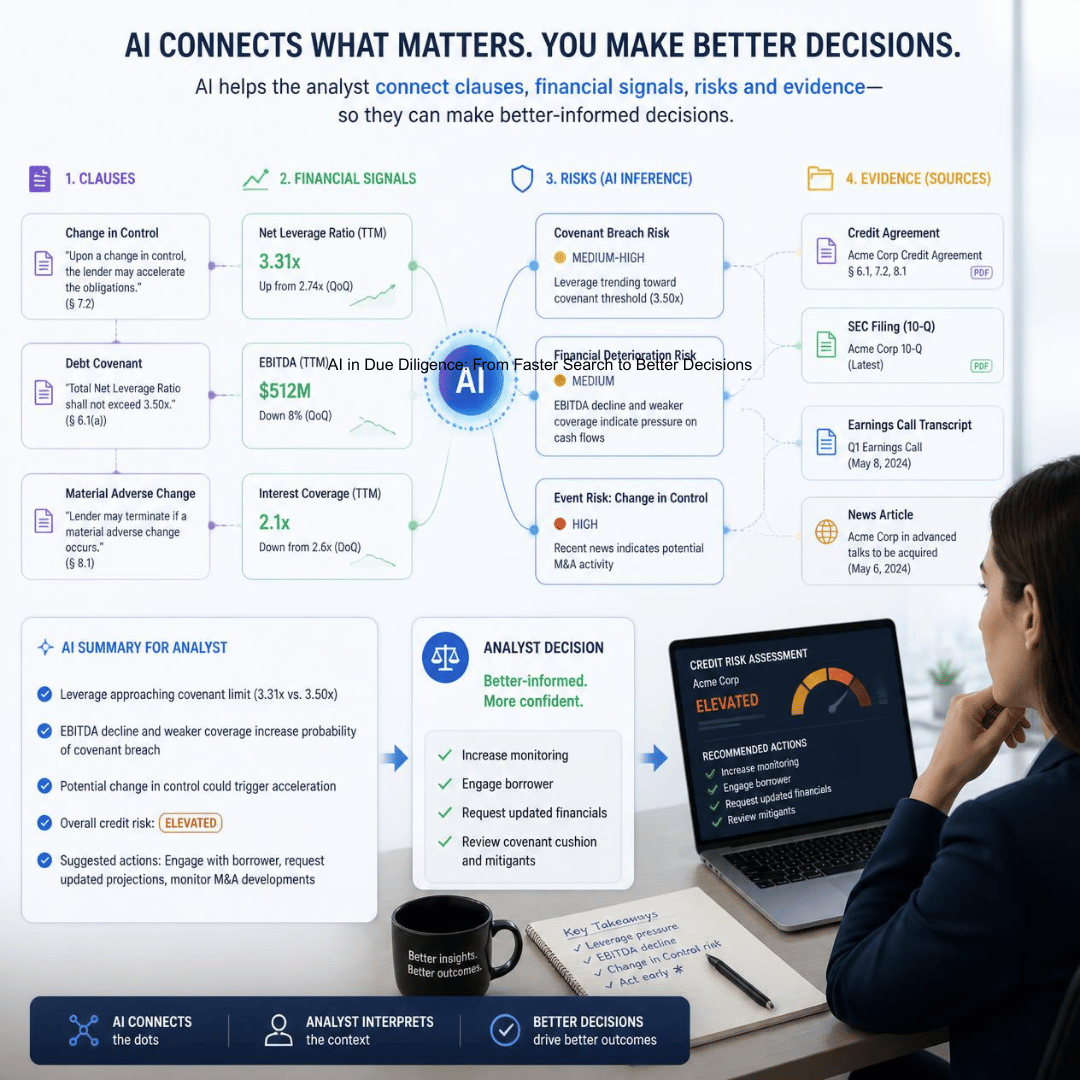
Workflow 2: evidence-linked issue extraction
Problem: important clauses and exceptions are found in documents but lose their source or downstream consequence when copied into reports.
Controlled agent role:
- extract defined clauses, thresholds or exceptions;
- link each finding to the exact source passage;
- compare related documents and amendments;
- propose an issue category, affected entity and reviewer;
- flag missing evidence or contradictory information.
Human gate: determine interpretation, materiality and the final diligence conclusion.
Success measures: evidence-link validity, recall on a reviewed sample, correction rate and time to first expert review.
Workflow 3: meeting decisions and action orchestration
Problem: steering and workstream meetings generate decisions and actions that are dispersed across minutes, email and trackers.
Controlled agent role:
- draft decisions, actions, owners and due dates from approved meeting records;
- match proposed actions to existing risks and milestones;
- ask owners to confirm assignments;
- prepare the next agenda around overdue decisions and dependencies;
- maintain a decision trail as status changes.
Human gate: confirm decisions, owners and any action that changes scope, budget or critical path.
Success measures: confirmation time, orphan actions, decision latency and overdue critical actions.
Workflow 4: Day 1 readiness monitoring
Problem: a large Day 1 plan can show high completion while a few unsupported critical items remain hidden.
Controlled agent role:
- check critical items for owners, evidence, dependencies and contingencies;
- identify inconsistent status across related workstreams;
- surface milestones threatened by a delayed condition or decision;
- draft exception-focused readiness summaries;
- route missing evidence to accountable owners.
Human gate: approve critical-item readiness and any change to the Day 1 scope.
Success measures: evidence coverage, unresolved dependencies, late critical failures and variance between reported and actual readiness.
Workflow 5: synergy evidence and variance management
Problem: synergy trackers often capture forecast and actual values without preserving assumptions, prerequisites or supporting evidence.
Controlled agent role:
- collect updates from initiative owners;
- compare actuals with approved baselines;
- identify missing evidence and changed assumptions;
- flag double counting or dependent initiatives;
- draft variance explanations and forecast scenarios.
Human gate: approve baseline changes, financial recognition and revised commitments.
Success measures: evidence completeness, forecast accuracy, approval latency and unresolved variance.
What is not ready for autonomous execution
Final valuation, legal interpretation, acceptance of material red flags, regulatory representations, sensitive personnel decisions and binding negotiation positions should remain accountable human decisions. AI can prepare evidence and scenarios; it should not own the consequence.
Failure modes shared by all five workflows
The use cases differ, but the same control failures recur:
- False completion: the agent closes an item because a file exists, although the evidence does not answer the request.
- Duplicate action: a retry creates a second request, task or notification.
- Stale authority: the agent acts on a superseded baseline, contract or owner list.
- Scope leakage: information from another entity, bidder or clean-team environment enters the result.
- Silent degradation: a model or tool update reduces quality while outputs still look convincing.
- Human shadow work: users spend more time checking and repairing automation than the reported saving suggests.
Design the pilot around these failures, not only the happy path. The control objective is reliable business completion with evidence—not maximum autonomous activity.
A stage-gated rollout for controlled agents
A workflow should earn additional authority in stages.
- Shadow: the agent proposes outputs while the existing process remains authoritative. Compare both results.
- Assist: users accept, edit or reject proposals; every correction is captured for evaluation.
- Act with approval: the agent prepares a state change that a named owner must authorize.
- Bounded action: low-risk actions may execute within narrow rules, with sampling and exception review.
- Scale: expand to more entities or workstreams only after quality, access and outcome thresholds remain stable.
Each gate should define minimum task success, maximum correction and incident rates, required evidence coverage and a rollback procedure. McKinsey’s January 2026 survey reported meaningful cost and cycle-time benefits among M&A users of generative AI, but also limited moderate-to-high adoption. The implication is not to wait; it is to industrialize the learning process instead of mistaking early usage for operating maturity.
One governed platform creates a safer foundation
These workflows become difficult when an agent must cross unrelated email, document, task and reporting systems. Each connector adds identity, version and error-handling complexity.
smartmerger.com already brings diligence, tasks, risks, decisions, Day 1 readiness, synergy management and integration work into purpose-built apps with shared permissions and structured data. That creates a defined process state on which future or connected agents could propose controlled changes while retaining evidence inside the same environment.
Run the five workflows as a portfolio, not five experiments
Choose one or two pilots that share the same data and governance foundation. Define common controls for identity, logging, approvals, source links, retries and incident response. Then compare the pilots on value and risk.
A useful portfolio scorecard includes:
- hours of coordination removed;
- cycle-time improvement;
- quality and correction rate;
- percentage of actions completed without human rework;
- security or permission exceptions;
- user trust and adoption;
- impact on the actual deal outcome.
Stop or redesign workflows that save time but create hidden review burden or weak evidence.
Include the cost of control in the business case
Time saved by an agent is not net value if reviewers must reconstruct evidence, administrators resolve permission failures or teams maintain duplicate trackers. Measure evaluation, monitoring, exception handling and incident response alongside automation benefits. A smaller workflow with reliable controls may outperform a broader one that creates hidden work.
Controlled automation is the practical path to agency
The first successful M&A agents will not negotiate transactions or decide whether to close. They will reduce the coordination tax around expert work: finding, routing, checking, connecting and following up.
That is enough to create material value. When the workflow is bounded, permissions are narrow and humans retain consequential decisions, agentic AI can improve speed without sacrificing control—and build the evidence required for the next level of adoption.


.png?width=1080&height=1080&name=ChatGPT%20Image%20Jul%2021%2c%202026%2c%2002_08_08%20PM%20(1).png)



.png?width=1080&height=1080&name=ChatGPT%20Image%20Jul%2021%2c%202026%2c%2002_08_09%20PM%20(2).png)