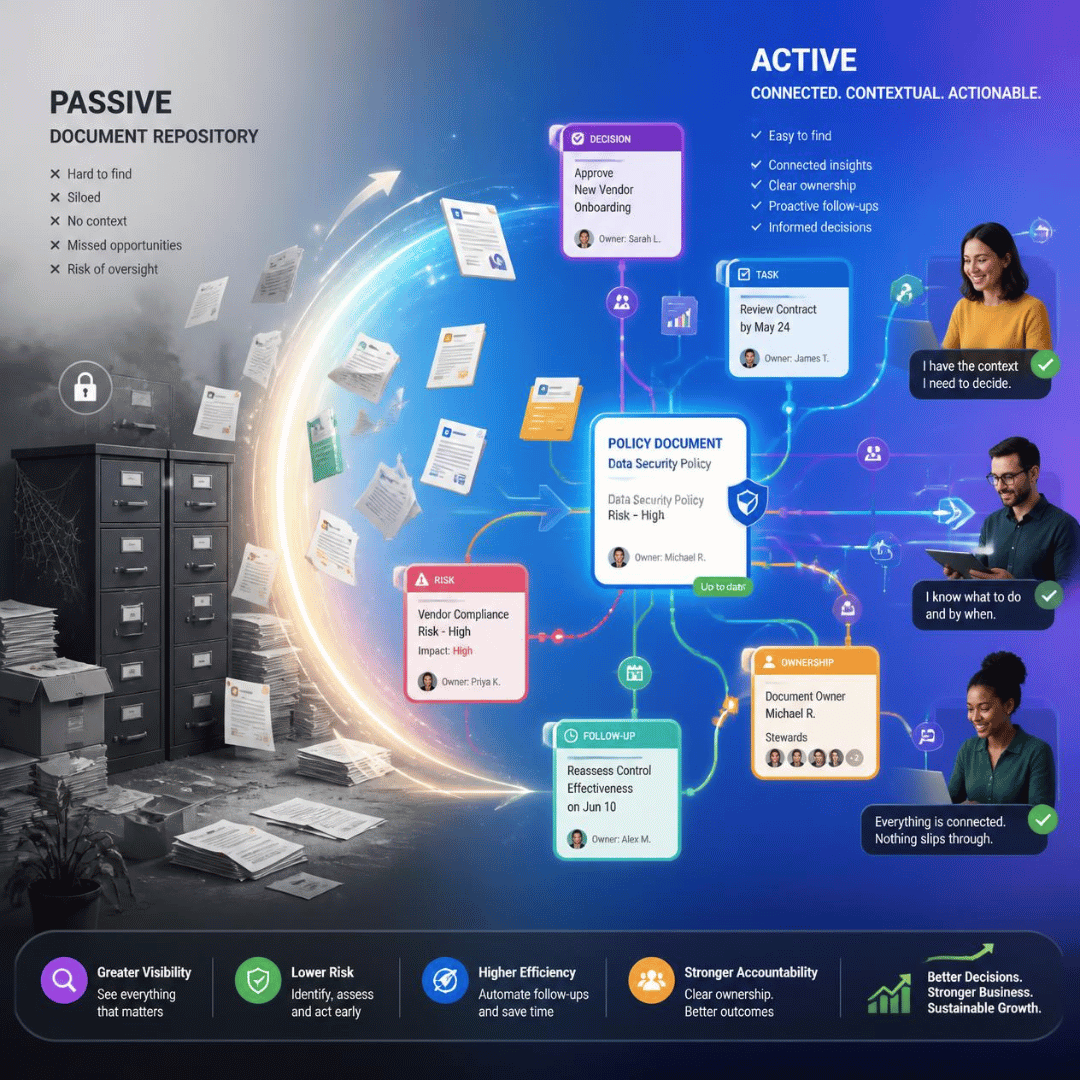

AI can summarize documents and answer questions. But M&A does not run on chat answers. It runs on structured data, workflows, permissions, approvals, reports, and accountable decisions.

That is why MCP matters. The Model Context Protocol allows AI systems to connect with tools, data sources, and business applications. For M&A, the real opportunity is not simply better AI chat. It is MCP-enabled, governed, end-to-end deal execution.

From AI Chat to M&A Execution

Artificial intelligence is already changing how deal teams work with information. M&A professionals use AI to summarize documents, draft reports, compare answers, extract obligations, prepare checklists, and accelerate first-pass analysis.

That is useful. But in M&A, it is not enough.

A transaction is not a chat conversation. It is a controlled process involving confidential information, multiple stakeholders, strict permissions, legal relevance, deadlines, approvals, and accountability. The question is therefore not only whether AI can produce an answer. The more important question is whether that answer can safely become part of the deal process.

This is where MCP becomes relevant.

MCP, the Model Context Protocol, is an open standard that allows AI applications to connect with external data sources, tools, and workflows in a structured way. In simple terms, it helps AI move beyond an isolated chat window and interact with approved systems.

For M&A, however, MCP should not be understood as a simple document-reading mechanism. Its real value emerges when it is embedded into an end-to-end M&A operating environment, where AI-generated output can become structured, traceable, shareable, governed, and human-approved deal data.

That is the strategic shift: from AI chat to MCP-enabled M&A execution.

In this Post...

1. What MCP Means for M&A

MCP stands for Model Context Protocol. It provides a standardized way for AI systems to connect with external tools, data sources, and applications. Instead of building a separate custom integration for every system, MCP gives AI applications a common method for discovering available tools, accessing approved context, and returning structured results.

A simple analogy is that MCP works like a universal connector for AI. It can allow an AI assistant to retrieve documents, query a database, call a business application, retrieve workflow data, or use a specific tool within defined technical boundaries.

In M&A, this matters because context is everything.

A due diligence question is rarely answered by one document alone. It may require input from contracts, financial models, Q&A logs, risk registers, synergy assumptions, integration plans, carve-out workstreams, management presentations, legal memos, and internal playbooks.

If AI only sees a single uploaded file, its answer will be limited. If AI can access the right approved context across the M&A lifecycle, it becomes far more useful.

But M&A also exposes the limits of a purely technical view of MCP.

Access is not the same as governance. A connected AI system can retrieve more information, but that does not automatically make its output reliable, approved, compliant, or decision-ready. The more sensitive the transaction, the more important it becomes to control what AI can access, what it can do, what it can change, and who must approve the result.

That is why the central M&A question is not just: can AI connect to the data?

The better question is: can AI interact with the end-to-end M&A process in a governed way?

2. Why AI Chat Is Not Enough

Most AI use in business still begins in a chat interface. A user asks a question. The AI reads a document or dataset. It provides a summary, a draft, or a recommendation. The answer may be helpful, but it usually remains separate from the actual work.

Then the manual work begins.

Deal teams copy AI output into Excel, PowerPoint, Word, Teams, SharePoint, a project plan, a diligence tracker, a risk register, or an email. They reconcile versions, check sources, chase approvals, update status reports, and try to remember which document supported which conclusion.

This creates a familiar problem: AI accelerates content creation, but not necessarily process execution.

In M&A, that can even increase complexity. More summaries, more draft reports, and more disconnected outputs do not automatically improve decision quality. They can create another layer of information that has to be checked, governed, and maintained.

A senior deal team does not need another private chat history. It needs controlled execution across the full M&A lifecycle.

If AI identifies a contractual risk, the finding should not disappear into a conversation. It should be linked to the source, reviewed by the responsible person, added to the relevant risk register, assigned if action is required, and made available to the right stakeholders.

If AI extracts a closing obligation, it should not remain as text in a chat response. It should become structured information that can support task ownership, readiness tracking, and reporting.

If AI prepares a diligence summary, the team should know which sources were used, who reviewed the output, what changed, and whether the result is approved for broader circulation.

That is the difference between AI as a drafting assistant and AI as part of end-to-end M&A execution.

Want to see MCP-enabled M&A execution in practice? Talk to smartmerger.com about building a secure, structured, and human-verified M&A workspace for your next transaction, integration, carve-out, or transformation program.

Contact Us

3. MCP as the Interaction Layer for End-to-End M&A

MCP becomes powerful in M&A when it is treated as an interaction layer for the entire deal process, not merely as a tool for reading documents.

In a traditional AI chat, the user receives an answer.

In an MCP-enabled M&A operating environment, the user works with AI inside the process.

This is the important shift. AI should not sit beside the M&A workflow as a separate assistant. It should support the controlled environment where people, documents, data, tasks, playbooks, reports, approvals, and decisions already come together.

That is exactly where smartmerger.com is positioned.

smartmerger.com is built as a secure, end-to-end M&A workspace. It supports the transaction lifecycle from strategy and preparation through due diligence, transaction management, signing, closing, post-merger integration, transformation, carve-outs, and divestitures.

As an MCP-enabled M&A platform, smartmerger.com can move AI beyond isolated answers and into governed process interaction. AI-generated information can be connected to the relevant workflow, structured inside the platform, reviewed by responsible users, and reused as part of the deal record.

This matters because M&A value is not created by producing another document. Value is created when information becomes usable for execution.

  • It can become structured data.
  • It can become a task.
  • It can become a risk item.
  • It can become a report input.
  • It can become a decision record.
  • It can become reusable knowledge.

That is what makes MCP strategically relevant for M&A. It enables AI to interact with the process, not only comment on it.

4. What End-to-End AI Support Looks Like in M&A

An MCP-enabled M&A platform becomes especially valuable when AI can support the full transaction lifecycle rather than one isolated phase.

Strategy and Target Screening

AI can help structure market insights, prepare target profiles, enrich strategic evaluation criteria, compare opportunities, and support decision preparation.

Preparation and Due Diligence

AI can summarize documents, extract relevant facts, populate structured tables, identify missing information, support due diligence request lists, and prepare evidence-based findings for review.

Transaction Management

AI can help track workstreams, prepare status updates, highlight open risks, and support structured collaboration between internal teams and external advisors.

Signing, Closing, and Day One Readiness

AI can support readiness checks, organize obligations, prepare reporting, and help teams maintain a clear view of open actions before critical transaction milestones.

Post-Merger Integration and Transformation

AI can support integration planning, synergy tracking, KPI reporting, issue escalation, and the continuous governance of value creation initiatives.

Carve-Outs and Divestitures

AI can help structure separation planning, TSA management, standalone readiness, dependency tracking, and complex multi-party coordination.

The end-to-end point is critical. Many tools solve fragments of the M&A process. smartmerger.com is designed to connect the lifecycle. MCP-enabled AI becomes most valuable when it can operate within that connected environment, under clear governance and human control.

5. Governing AI-Generated M&A Data

In M&A, speed without governance is not enough.

AI-generated output must be controlled, reviewed, and traceable. This is especially important because M&A data is highly sensitive and often legally, commercially, or strategically relevant. Confidentiality, permissions, auditability, and human approval are not optional. They are part of responsible deal execution.

This is also where AI governance becomes practical rather than abstract.

A useful M&A AI model should be able to propose, summarize, classify, extract, structure, and accelerate. But humans must validate, approve, and remain accountable. AI can support judgement, but it should not replace professional responsibility.

Governed AI-generated M&A data should meet four requirements.

Shareable

AI output should not disappear in a private chat history. It should be available to the right stakeholders in the right context, according to the right permissions.

Traceable

Teams should understand where the information came from, which sources were used, what the AI generated, and what a human reviewer changed or approved.

Controlled

AI interaction with systems should follow role-based permissions, secure access rules, review workflows, and audit trails. MCP can create useful connections, but those connections need strong authorization, least-privilege access, and clear boundaries.

Human-Approved

AI output should become reliable M&A information only after the responsible person has reviewed and approved it.

This is the difference between AI output and M&A data.

A chat answer may be useful for orientation. Governed M&A data can be used for collaboration, reporting, decision preparation, and execution.

6. Why smartmerger.com Is MCP-Enabled for Governed End-To-End M&A

smartmerger.com approaches MCP from the perspective of M&A execution.

The purpose is not to add another AI chat layer. The purpose is to make AI usable inside a secure, structured, permission-based M&A workspace built specifically for the transaction lifecycle.

As an MCP-enabled M&A platform, smartmerger.com is designed to connect AI interaction with the operating reality of deal work: structured data, workflows, documents, playbooks, tasks, permissions, reporting, and human verification.

This is where the platform approach matters.

In smartmerger.com, AI-generated information is not treated as a loose artefact. It can be processed further inside the platform, connected to the relevant workflow, governed by permissions, and made available for collaboration and decision-making.

AI can help users work with validated internal knowledge. It can support structured data capture. It can help prepare evidence-driven insights. It can assist with risk identification, reporting, and workflow preparation. It can reduce manual handling of information across the deal lifecycle.

But the operating principle remains clear: AI supports the process; people remain in control.

Human verification is essential. AI-generated output should be inspected, approved, and governed before it becomes part of the deal record. This is particularly important where findings may influence negotiation positions, diligence conclusions, integration priorities, or board-level reporting.

That is why MCP is not just a technical feature in M&A. It is part of a broader operating model for governed, end-to-end deal execution.

7. Why Security and Sovereignty Still Matter

MCP can make AI more useful because it gives AI a structured way to connect with tools and data. But that also expands the governance challenge.

Once AI can access systems, call tools, or interact with workflows, security design becomes central. M&A teams need to know which systems are connected, what data is available, what actions are permitted, how credentials are managed, how tool use is logged, and where human approval is required.

This is especially important in European M&A.

European deal teams often operate under strict confidentiality expectations, GDPR obligations, cross-border transfer considerations, sector-specific security requirements, and increasing scrutiny of AI governance. In that environment, server location is relevant, but it is not the only question. Provider jurisdiction, legal control, subprocessors, access rights, encryption, auditability, and operational governance all matter.

For highly confidential transactions, the diligence question should therefore be broader than “where is the server hosted?”

  • Who operates the platform?
  • Which legal framework applies to the provider?
  • Who can access the data, under what conditions, and from where?
  • Which subprocessors are involved?
  • How are permissions enforced?
  • Can AI output be traced back to source material?
  • Can sensitive AI actions require human approval?
  • Can the organization prove what happened later?

MCP does not remove these questions. It makes them more important.

The more AI becomes connected to deal execution, the more M&A teams need a secure and governed operating model around it.

Conclusion: The Future Is Not Better Chat. It Is Governed End-to-End Execution.

MCP is an important step in the evolution of enterprise AI. It gives AI systems a standardized way to connect with tools, data sources, and workflows. For M&A, that is highly relevant because deal execution depends on context.

But MCP alone is not the answer.

In M&A, the real value begins when AI output becomes part of a governed end-to-end process. A summary should be traceable. A risk should be reviewable. A diligence finding should be structured. A recommendation should be approved. A task should have an owner. A decision input should have a source.

That is why the future of AI in M&A is not simply AI chat with better access to documents.

It is MCP-enabled AI inside a secure M&A operating environment: connected, permission-based, traceable, shareable, and human-approved.

For European deal teams, this also means taking sovereignty, legal control, security, and governance seriously from the beginning. The more AI becomes connected to deal execution, the more important the operating model becomes.

MCP can help AI reach the process.

smartmerger.com helps make that process governed, end-to-end, and ready for serious M&A work.

Michael Klawon

Michael Klawon

CEO and Founder of smartmerger.com

View Profile

Article Topics

M&A Platform
smartmerger.com
Digitalization
Artificial Intelligence (AI)